

Walk into any kitchen store and you'll see a wall of knives designed to make you feel inadequate. Santokus, nakiris, boning knives, fillet knives, something called a "utility knife" that isn't utility at all. The salesperson will happily sell you a twelve-piece block set for $400. You don't need it. I've cooked professionally and at home for close to fifteen years, and I can count on one hand the knives I actually reach for.
Here's the honest answer to what are the essential kitchen knives every home cook should own: three knives cover 95% of everything you'll ever do. A chef's knife, a paring knife, and a serrated bread knife. Everything else is a luxury, a hobby, or a trap. That said, the details matter enormously — blade length, steel type, how you hold the thing — and most guides skip straight past them.
Key Takeaways
- Three knives handle nearly all home cooking: chef's knife (20 cm / 8 inches for most adults), paring knife (8–10 cm), serrated bread knife.
- Blade length should match your hand and cutting board, not your ego. A 15 cm chef's knife beats a 25 cm one for anyone with smaller hands.
- Steel type matters more than brand: stainless for low maintenance, carbon for edge retention if you'll actually dry it.
- Kitchen shears belong in the essential conversation — many cooks use them daily.
- Sharpening beats buying. A $40 knife you sharpen monthly outperforms a $200 knife you never touch.
- Skip the block set. Buy individual knives and a magnetic strip or blade guards.
Essential kitchen knives: the honest short list
The first knife I ever bought was a 25 cm German chef's knife. Massive thing. I felt like a proper chef holding it. Then I spent six months fighting it — my wrist ached, my cuts were clumsy, and I kept nicking my knuckles because the blade was longer than my cutting board was wide. Nobody told me the obvious: a knife should feel like an extension of your arm, and my arm is not 25 cm long.
What are the 3 most essential knives for a kitchen?
The three indispensable knives are the chef's knife, the paring knife, and the serrated bread knife. This trio handles chopping, mincing, peeling, slicing bread, and cutting tomatoes. If you owned nothing else, you could cook every meal in this article without frustration.
The chef's knife does the heavy lifting. Rocking, chopping, dicing onions, breaking down a chicken, crushing garlic. Its curved belly lets you rock the blade instead of pushing straight down, which is why it feels faster than a santoku for most Western cooking. A 20 cm blade suits the average adult hand; go 15 cm if you're shorter than about 165 cm or have small hands, and 25 cm only if you're genuinely tall and cook large volumes.
The paring knife is the precision tool. Hulling strawberries, peeling apples, deveining shrimp, trimming fat. It's small, cheap, and endlessly useful. Don't overthink this one — a $15 paring knife does the job.
The serrated bread knife is the most underrated knife in any kitchen. It saws through crusty bread, yes, but also through tomatoes without crushing them, through cake layers, through citrus rind. The serrations do the work so you don't have to press hard.
What are the 7 essential knives every cook needs?
If you want to go beyond the core three, here's where the list stretches to seven — but treat the last four as "nice to have, buy when a specific task annoys you."
- Chef's knife — the workhorse, 20 cm for most people
- Paring knife — small tasks, 8–10 cm blade
- Serrated bread knife — bread, tomatoes, cake
- Kitchen shears — not technically a knife, but I use mine as often as my paring knife. Spatchcocking chicken, cutting herbs, opening packages.
- Utility knife — a 12–15 cm middle ground between chef's and paring. Honestly? Skip it unless you find one cheap. The chef's knife covers this range.
- Boning knife — flexible, narrow blade for working around bones. Worth it if you break down whole chickens or fish regularly.
- Slicing/carving knife — long, thin blade for roasts and large cuts of meat. Buy it when you start hosting holiday dinners.
Notice what's absent: the cleaver (you're not breaking down carcasses), the nakiri (a chef's knife does vegetables fine), the fillet knife (unless you fish), and the infamous "utility knife" that no one can define.
What is the most versatile of all kitchen knives?
The chef's knife. Every time. Ask any cook who works a line and they'll tell you the same thing: if they could only grab one blade, it's the chef's knife. Its length lets you slice a cabbage in one motion, its belly lets you rock-chop herbs, and its flat spine lets you scoop what you just cut.
But "versatile" isn't the same as "best for every task." I've watched people try to peel a shallot with a 20 cm blade and end up with bloody fingers. The chef's knife is the default, not the only answer.
A note on santokus, since they come up constantly. A santoku is shorter, flatter, and has a sheep's-foot tip. It's excellent for slicing and dicing vegetables. It's terrible for rocking motions and for breaking down meat. If you mostly cook stir-fries and salads, a santoku might genuinely suit you better than a Western chef's knife. Otherwise, stick with the chef's knife.
Which chef's knife should you actually buy?
Blade material is where most home cooks get lost. Two real options:
- Stainless steel (most common): won't rust, dishwasher-tolerant (though you still shouldn't), holds a decent edge. Easy mode.
- High-carbon steel: takes a sharper edge and holds it longer, but rusts if you leave it wet. Best for people who enjoy maintenance.
On the handle side, there's no wrong answer: Western riveted handles are heavier and feel more substantial, while Japanese-style handles are lighter and shift the balance toward the blade. Neither is superior — it's about what feels right in your hand. Go to a store and hold a few. You'll know within five seconds which one you want to keep holding.
Price floors: around $40 gets you a genuinely good chef's knife — Victorinox and Mercer both make models in that range that chefs actually use in professional kitchens. The jump to $150 buys nicer steel and prettier handles, not a sharper cut. The jump to $300 buys craftsmanship. Nothing wrong with that, but don't confuse it with necessity.
| Knife | Typical blade length | Primary use | Sensible budget | Priority |
|---|---|---|---|---|
| Chef's knife | 15–25 cm | Chop, dice, slice almost anything | $40–$200 | Essential |
| Paring knife | 8–10 cm | Peel, trim, precision work | $10–$40 | Essential |
| Bread knife | 20–25 cm | Bread, tomatoes, cake | $20–$60 | Essential |
| Kitchen shears | — | Poultry, herbs, packaging | $15–$30 | High |
| Boning knife | 12–15 cm | Whole chickens, fish | $15–$50 | Situational |
| Carving knife | 20–25 cm | Roasts, large cuts | $25–$80 | Situational |
What are the best everyday kitchen knives?
Everyday knives need to survive actual daily use, which means three things: they hold an edge reasonably well, they don't demand obsessive care, and they're comfortable enough that you don't avoid using them. That last point is more important than most reviews admit. A knife you dislike sits in the drawer while you hack at onions with a dull paring knife.
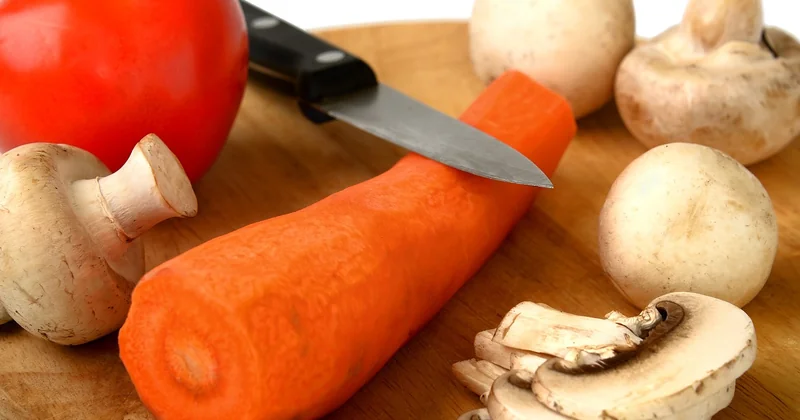
What I've learned from testing knives in a real, messy home kitchen: you do not need expensive knives, but you do need sharp ones. I've cooked with $200 Japanese blades that felt sublime and with a $35 Victorinox that performed almost as well after a quick sharpening. The difference showed up in edge retention over months, not in the actual cut.
Steel, care, and the thing nobody tells beginners
I ruined a good knife once by leaving it in the sink overnight after cutting lemons. The acid etched the blade. Not catastrophic, but visible, and it taught me a rule I now follow without thinking: wash by hand, dry immediately, put it away. Never the dishwasher. The heat and the detergent and the knocking around against other dishes will destroy an edge and wear down the handle faster than any cutting will.
Sharpening is the real skill, and it's the one most people skip. Two tools matter:
- A honing steel — used before cooking, it realigns the edge that bends during cutting. Takes ten seconds.
- A whetstone or a pull-through sharpener — actually removes metal to create a new edge. Once every few weeks for home cooks.
A honing steel does not sharpen. This confused me for years. If your knife is genuinely dull, no amount of honing will fix it — you need to grind a new edge. Ten minutes on a whetstone every month or two transforms a mediocre knife into something that cuts like new.
Storage matters too. A magnetic strip on the wall keeps knives dry and visible. Blade guards work if you're drawer-storing. A wooden block is fine if it's clean inside. What you shouldn't do is toss them loose in a drawer where they bang against each other and dull every day.
Mistakes I made so you don't have to
Buying a block set was my first mistake. Twelve knives, and I used three. The rest collected dust and took up counter space. The "free" steak knives were stamped junk that bent the first time I cut through a chicken breast.
My second mistake was buying a knife that looked good in photos rather than one that felt right in my hand. I ordered online based on reviews and specs. It arrived, felt clumsy, and I kept using it anyway because I'd spent the money. Pride is expensive.
The third mistake — and this one took years to fix — was ignoring sharpening. I assumed a decent knife stayed sharp. It doesn't. It degrades slowly enough that you never notice, until one day you're pressing down hard to cut a tomato and wondering why cooking feels like work. That's not the knife's fault. That's you, not maintaining it.
Do I need a knife block or a set?
No. Buy three or four individual knives and store them on a magnetic strip or with blade guards. Sets pad the count with knives you'll never use and dilute the quality of the ones you will.
How often should I sharpen my knives?
Home cooks: every four to eight weeks with a whetstone, and hone before each use. If you cook daily and cut a lot of acidic foods, go shorter. If you cook twice a week, longer. Feel matters more than schedule — when a tomato squashes instead of slicing, it's time.
Is a santoku better than a chef's knife?
Depends on what you cook. Santokus excel at slicing vegetables and are lighter in the hand. Chef's knives handle rocking motions and breaking down meat better. For a single all-purpose knife, the chef's knife wins, but a santoku is a perfectly reasonable choice if your cooking leans vegetable-heavy.
The one thing that actually matters
You could spend a year researching steel grades, Rockwell hardness, and blade geometry. Or you could buy three decent knives, learn to hold them correctly, and actually sharpen them when they dull. The second path produces better cooking.
What strikes me now, looking back at the knives I've owned and the ones I still reach for, is how little the price tag mattered compared to the maintenance. The $35 chef's knife I sharpened every month cut better than the $180 one I ignored. Every single time.
So the essential list stays short: a chef's knife sized to your hand, a paring knife, a serrated bread knife, and kitchen shears if you'll use them. Add a boning knife when you start breaking down whole chickens. Add a carving knife when you start roasting large cuts. Then stop. The rest is noise, and your counter space is better spent on a cutting board that's big enough to actually work on.


